When to use
Use method = "tree" when you suspect respondents apply a
hierarchical elimination rule — a lexicographic gatekeeper
attribute they check first, then a smaller cue conditional on it. The
root split identifies the gatekeeper. The tree uses only a subset of
available levels, consistent with respondents processing a few key cues
rather than all information at once.
Fit
tr <- cj_fit(f, data = immig, method = "tree")
tr
#> Conjoint Decision Tree
#> ======================
#>
#> Resolution: levels
#> Complexity (cp): 0.005
#> Root split: JobPlansno.plans.to.look.for.work
#> Depth: 4
#> Terminal nodes: 6
#> Observations: 2,000
#> Levels: 50
#>
#> Top 10 levels by importance:
#>
#> # A tibble: 10 × 4
#>     rank attribute      level                     importance
#>    <int> <chr>          <chr>                          <dbl>
#>  1     1 JobPlans       no plans to look for work      15.0
#>  2     2 PriorEntry     once w/o authorization          6.51
#>  3     3 Education      college degree                  3.81
#>  4     4 LanguageSkills used interpreter                3.49
#>  5     5 LanguageSkills fluent English                  3.21
#>  6     6 Gender         female                          0
#>  7     7 Gender         male                            0
#>  8     8 Education      4th grade                       0
#>  9     9 Education      8th grade                       0
#> 10    10 Education      graduate degree                 0
Plot
plot(tr)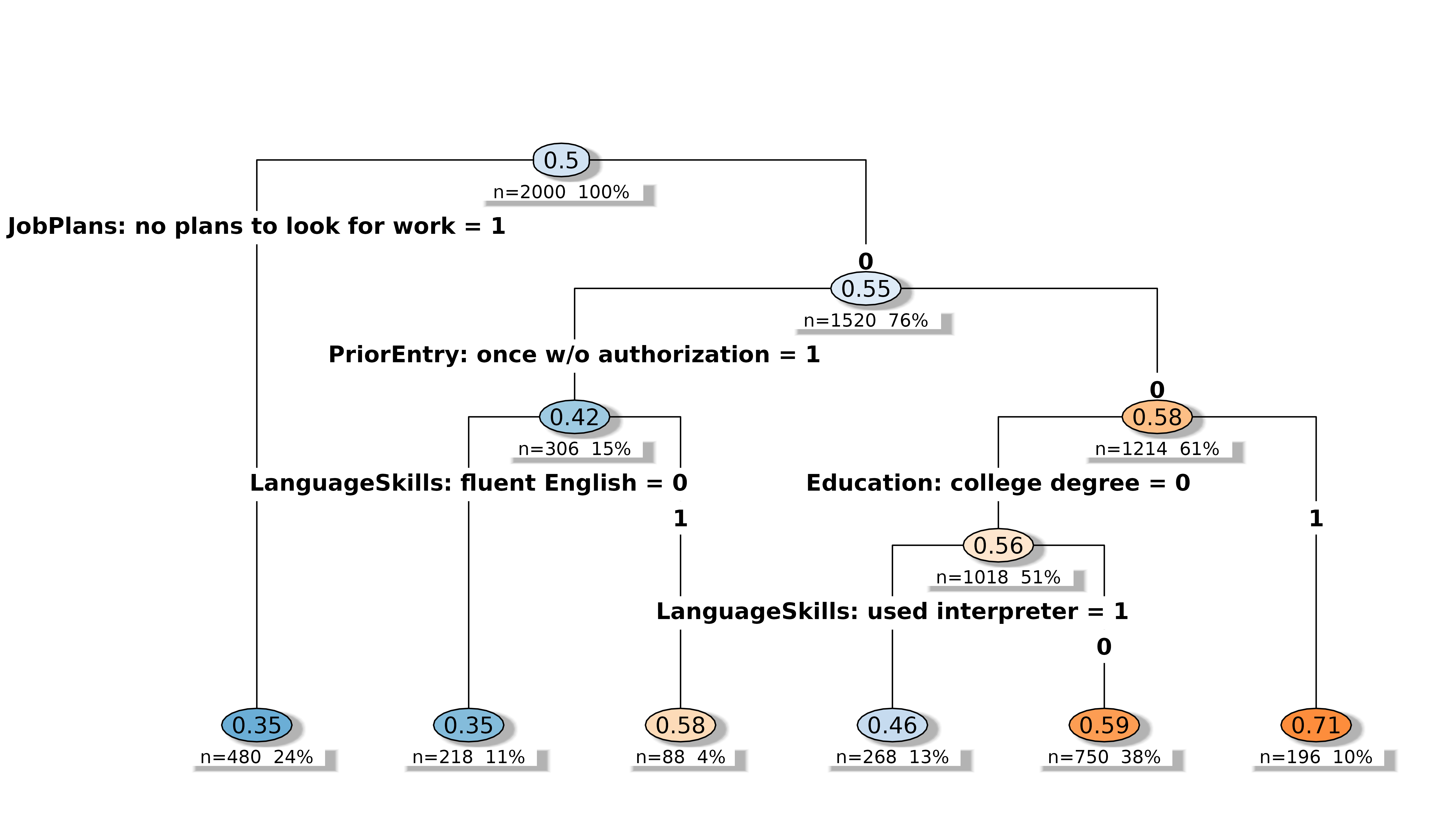
Splits are labelled Attribute: level
(e.g. JobPlans: no plans to look for work) so the
diagnostic is readable without per-dataset customisation.
Related
- Random Forest gives the population-level importance hierarchy that the tree’s splits draw from.
- Nested Marginal Means for an alternative sequential-elimination view that does not require fitting a tree.