CRT / HierNet: Which levels survive a strict signal-vs-noise test?
Source:vignettes/crt.Rmd
crt.RmdWhen to use
Use method = "crt" when you want a hard attendance
test: which attribute levels keep a non-zero coefficient under
increasing L1 penalty? Levels that vanish quickly under penalization are
noise or redundant; levels that survive the heaviest penalties genuinely
drive choices.
CRT requires the hierNet package. It is the most computationally expensive method in cjdiag.
Fit
crt <- cj_fit(f, data = immig, method = "crt",
              lambda_grid = c(5, 10, 20, 50, 100, 150, 200, 300, 500),
              n_folds = 3, n_perm = 5)
crt
#> Conjoint CRT/HierNet Model
#> ==========================
#>
#> Optimal lambda: 5
#> Lambda (1-SE rule): 5
#> Accuracy: 64.8%
#> Observations: 2,000
#> Attributes: 9
#> Levels: 50
#> Attended levels: 50 / 50
#>
#> Top 10 levels by MDA:
#>
#> # A tibble: 10 × 5
#>     rank attribute            level                       mda max_lambda
#>    <int> <chr>                <chr>                     <dbl>      <dbl>
#>  1     1 JobPlans             no plans to look for work 4.14         150
#>  2     2 JobPlans             contract with employer    3.49         100
#>  3     3 PriorEntry           once w/o authorization    1.88         100
#>  4     4 Education            college degree            1.81         100
#>  5     5 CountryofOrigin      Iraq                      1.77          50
#>  6     6 Education            no formal                 1.57         100
#>  7     7 LanguageSkills       used interpreter          1.28          50
#>  8     8 ReasonforApplication escape persecution        1.27          50
#>  9     9 LanguageSkills       fluent English            1.27         100
#> 10    10 ReasonforApplication seek better job           0.910         20
max_lambda is the largest λ at which the level still has
a non-zero coefficient. attended is a boolean derived from
max_lambda > 0.
Most signal-vs-noise separation happens between λ = 100 and λ = 500. Stopping the grid at λ = 50 (or lower) is a common mistake that makes nearly every level look “attended”: the penalty isn’t yet strong enough to eliminate the noise. Always extend the grid past λ = 200; the package default goes to 500.
Plot lambda survival
Two complementary views of the survival statistic.
type = "survival" shows each level’s coefficient path
across the lambda grid, so you can see at what penalty a level drops
out.
plot(crt, type = "survival")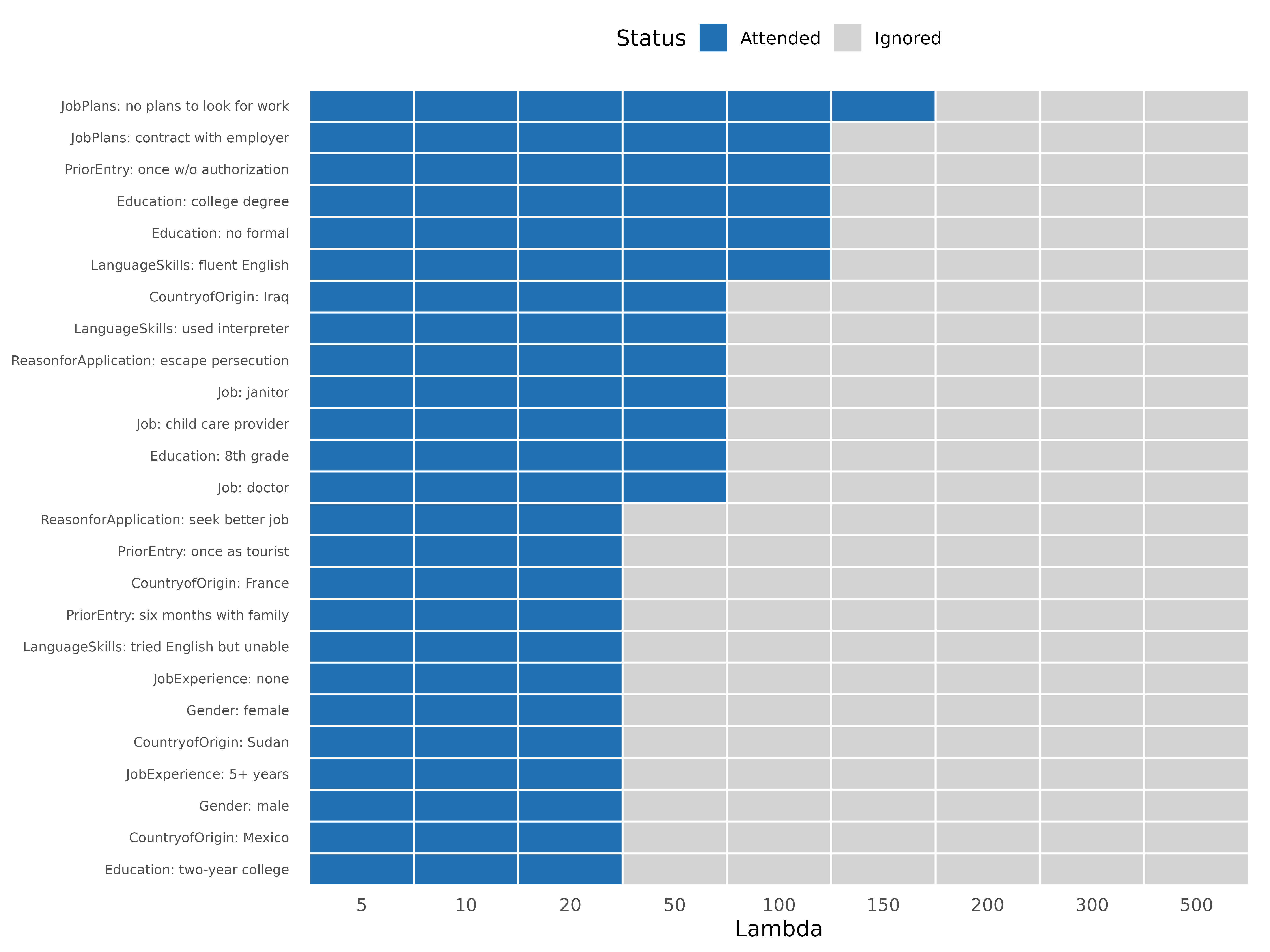
type = "rank" collapses each path to its
max_lambda and plots the levels in descending order — a
one-number attendance ranking in the same connected-dot style as
plot(forest, type = "rank").
plot(crt, type = "rank")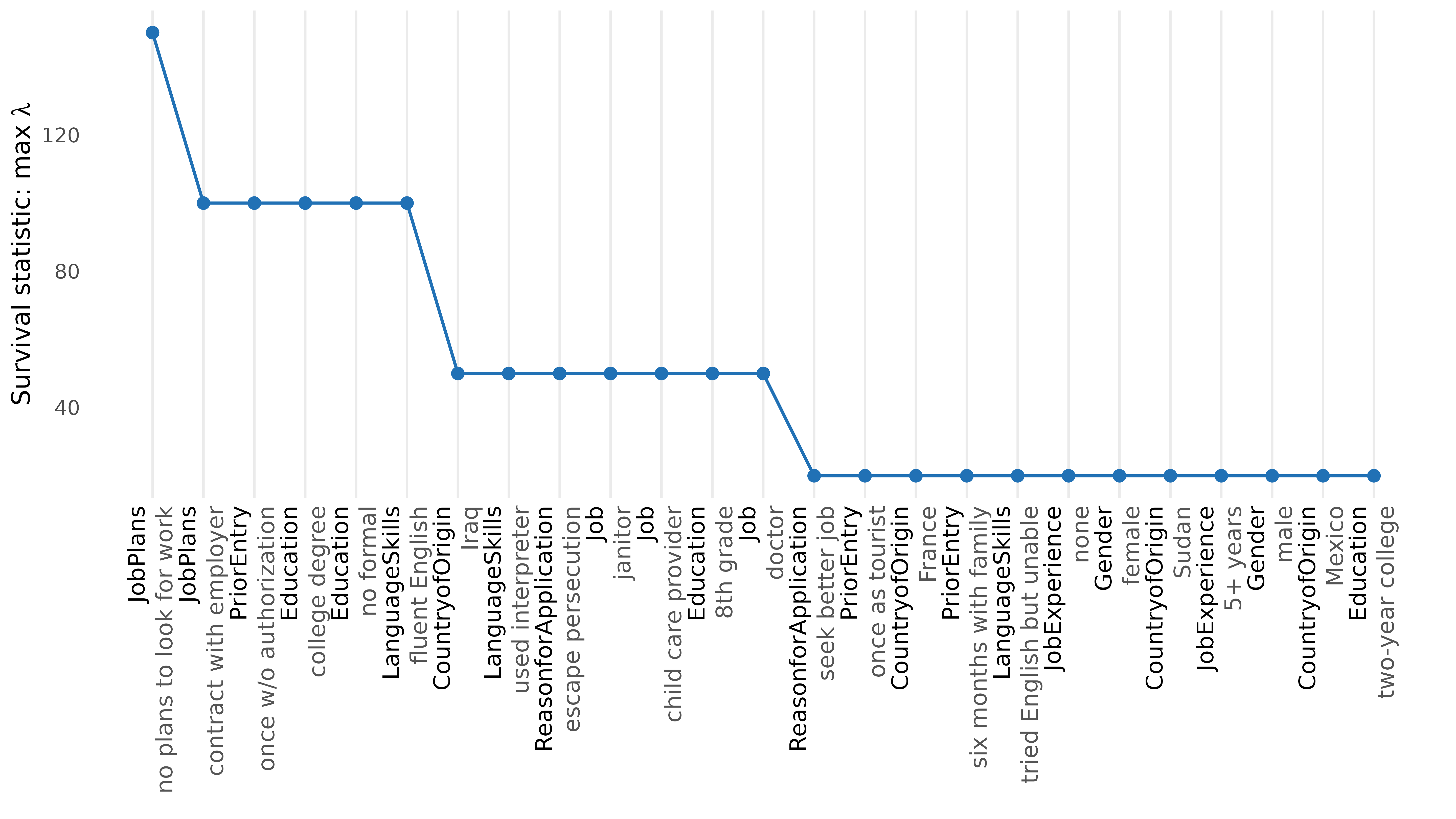
Related
- Marginal R-squared for a per-respondent attendance signal.
- Random Forest for a non-parametric importance ranking (no penalization).