publications
Publications.
Books and book chapters

-
Totale Überwachung: Warum wir uns freiwillig vom Staat die Freiheit rauben lassenDavid Karpa and Michael RochlitzOct 2026Forthcoming, October 2026Digitale Technologien haben die Vision von George Orwells „1984" zur realen Möglichkeit gemacht. KI, Gesichtserkennung und Big Data erlauben eine Kontrolle über Individuen, die noch vor wenigen Jahren undenkbar war. China hat diese Technologien zum Überwachungsstaat ausgebaut und exportiert sie entlang der digitalen Seidenstraße in dutzende Länder. In den USA ist nach dem 11. September 2001 eine Allianz aus Staat und Tech-Konzernen entstanden, die unter der Regierung Trump zur Abschiebungsmaschinerie wurde. Auch in Deutschland setzt die Polizei bereits Software des US-Unternehmens Palantir ein. Dr. David Karpa und Prof. Michael Rochlitz zeigen, wie Überwachungstechnologie unsere Freiheit bedroht und unter welchen Bedingungen Bürger auch in Deutschland bereit sind, staatliche Überwachung zu akzeptieren.
@book{karpa2026totale, title = {Totale {\"U}berwachung: Warum wir uns freiwillig vom Staat die Freiheit rauben lassen}, author = {Karpa, David and Rochlitz, Michael}, year = {2026}, month = oct, publisher = {Heyne}, address = {M{\"u}nchen}, isbn = {978-3-453-21935-9}, pages = {256}, language = {German}, url = {https://www.penguin.de/buecher/karpa-rochlitz-totale-ueberwachung/paperback/9783453219359}, note = {Forthcoming, October 2026}, category = {book}, } -
Artificial intelligence, surveillance, and big dataDavid Karpa, Torben Klarl, and Michael RochlitzIn Diginomics Research Perspectives: The Role of Digitalization in Business and Society, Oct 2022The most important resource to improve technologies in the field of artificial intelligence is data. Two types of policies are crucial in this respect: privacy and data-sharing regulations, and the use of surveillance technologies for policing. Both types of policies vary substantially across countries and political regimes. This chapter examines how authoritarian and democratic political institutions can influence the quality of research in artificial intelligence, and the availability of large-scale datasets to improve and train deep learning algorithms. We focus mainly on the case of China, and find that—ceteris paribus—authoritarian political institutions continue to have a negative effect on innovation. They can, however, have a positive effect on research in deep learning, via the availability of large-scale datasets that have been obtained through government surveillance. We propose a research agenda to study which of the two effects might dominate in a race for leadership in artificial intelligence between countries with different political institutions, such as the USA and China.
@incollection{karpa2022artificial, title = {Artificial intelligence, surveillance, and big data}, author = {Karpa, David and Klarl, Torben and Rochlitz, Michael}, booktitle = {Diginomics Research Perspectives: The Role of Digitalization in Business and Society}, pages = {145--172}, year = {2022}, publisher = {Springer}, category = {book}, }
Journal articles
-
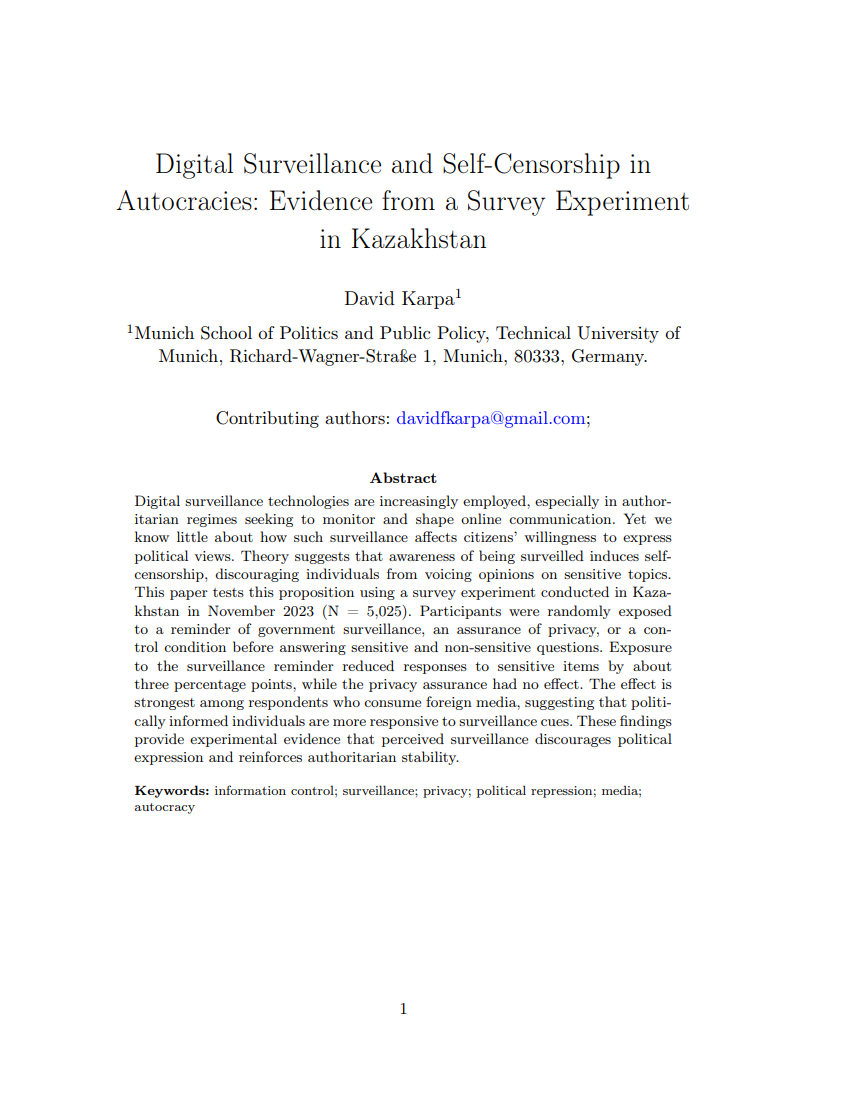
Digital Surveillance and Self-Censorship in Autocracies: Evidence from a Survey Experiment in KazakhstanDavid KarpaPolitical Behavior, 2026Digital surveillance technologies are increasingly employed, especially in authoritarian regimes seeking to monitor and shape online communication. Yet we have little empirical evidence about how such surveillance affects citizens’ expression of political views. Theory suggests that awareness of being surveilled induces self-censorship, discouraging individuals from voicing opinions on sensitive topics. This paper tests this proposition using a survey experiment conducted in Kazakhstan in November 2023 (N = 5,025). Participants were randomly exposed to a reminder of government surveillance, an assurance of privacy, or a control condition before answering sensitive and non-sensitive questions. Exposure to the surveillance reminder reduced responses to sensitive items by about three percentage points, while the privacy assurance had no effect. The effect is strongest among respondents who consume foreign media, suggesting that politically informed individuals are more responsive to surveillance cues. These findings provide experimental evidence that perceived surveillance discourages political expression and reinforces authoritarian stability.
@article{karpa2026selfcensorship, title = {Digital Surveillance and Self-Censorship in Autocracies: Evidence from a Survey Experiment in Kazakhstan}, author = {Karpa, David}, journal = {Political Behavior}, year = {2026}, category = {journal}, } -
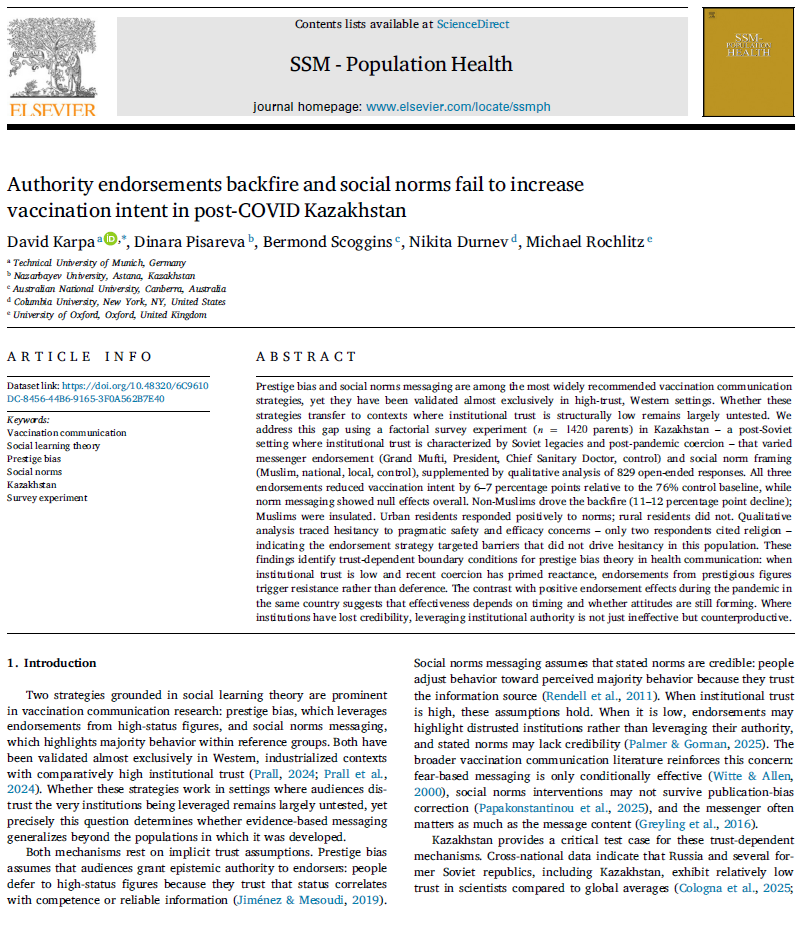
Authority endorsements backfire and social norms fail to increase vaccination intent in post-COVID KazakhstanDavid Karpa, Dinara Pisareva, Bermond Scoggins, and 2 more authorsSSM - Population Health, 2026Prestige bias and social norms messaging are among the most widely recommended vaccination communication strategies, yet they have been validated almost exclusively in high-trust, Western settings. Whether these strategies transfer to contexts where institutional trust is structurally low remains largely untested. We address this gap using a factorial survey experiment (n=1420 parents) in Kazakhstan – a post-Soviet setting where institutional trust is characterized by Soviet legacies and post-pandemic coercion – that varied messenger endorsement (Grand Mufti, President, Chief Sanitary Doctor, control) and social norm framing (Muslim, national, local, control), supplemented by qualitative analysis of 829 open-ended responses. All three endorsements reduced vaccination intent by 6–7 percentage points relative to the 76% control baseline, while norm messaging showed null effects overall. Non-Muslims drove the backfire (11–12 percentage point decline); Muslims were insulated. Urban residents responded positively to norms; rural residents did not. Qualitative analysis traced hesitancy to pragmatic safety and efficacy concerns – only two respondents cited religion – indicating the endorsement strategy targeted barriers that did not drive hesitancy in this population. These findings identify trust-dependent boundary conditions for prestige bias theory in health communication: when institutional trust is low and recent coercion has primed reactance, endorsements from prestigious figures trigger resistance rather than deference. The contrast with positive endorsement effects during the pandemic in the same country suggests that effectiveness depends on timing and whether attitudes are still forming. Where institutions have lost credibility, leveraging institutional authority is not just ineffective but counterproductive.
@article{karpa2026vaccination, title = {Authority endorsements backfire and social norms fail to increase vaccination intent in post-COVID Kazakhstan}, author = {Karpa, David and Pisareva, Dinara and Scoggins, Bermond and Durnev, Nikita and Rochlitz, Michael}, journal = {SSM - Population Health}, volume = {35}, pages = {101935}, year = {2026}, issn = {2352-8273}, doi = {10.1016/j.ssmph.2026.101935}, url = {https://www.sciencedirect.com/science/article/pii/S2352827326000376}, publisher = {Elsevier}, category = {journal}, keywords = {Vaccination communication, Social learning theory, Prestige bias, Social norms, Kazakhstan, Survey experiment}, } -
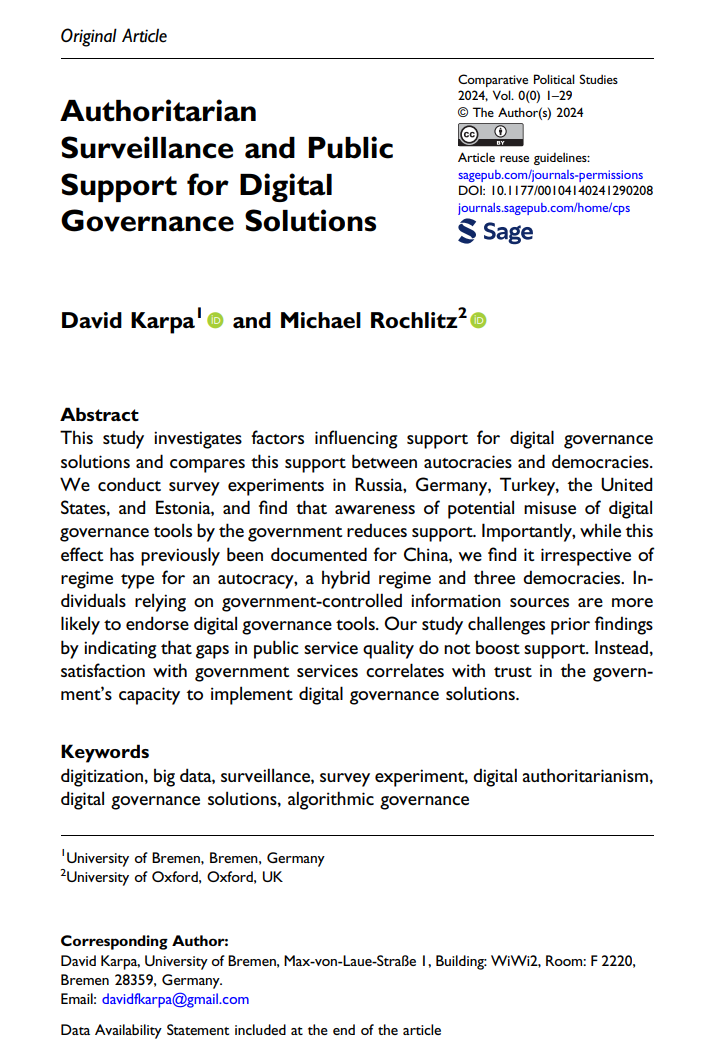
Authoritarian surveillance and public support for digital governance solutionsDavid Karpa and Michael RochlitzComparative Political Studies, 2025This study investigates factors influencing support for digital governance solutions and compares this support between autocracies and democracies. We conduct survey experiments in Russia, Germany, Turkey, the United States, and Estonia, and find that awareness of potential misuse of digital governance tools by the government reduces support. Importantly, while this effect has previously been documented for China, we find it irrespective of regime type for an autocracy, a hybrid regime and three democracies. Individuals relying on government-controlled information sources are more likely to endorse digital governance tools. Our study challenges prior findings by indicating that gaps in public service quality do not boost support. Instead, satisfaction with government services correlates with trust in the government’s capacity to implement digital governance solutions.
@article{karpa2025authoritarian, title = {Authoritarian surveillance and public support for digital governance solutions}, author = {Karpa, David and Rochlitz, Michael}, journal = {Comparative Political Studies}, volume = {58}, number = {10}, pages = {2237--2265}, year = {2025}, publisher = {SAGE Publications}, category = {journal}, } -
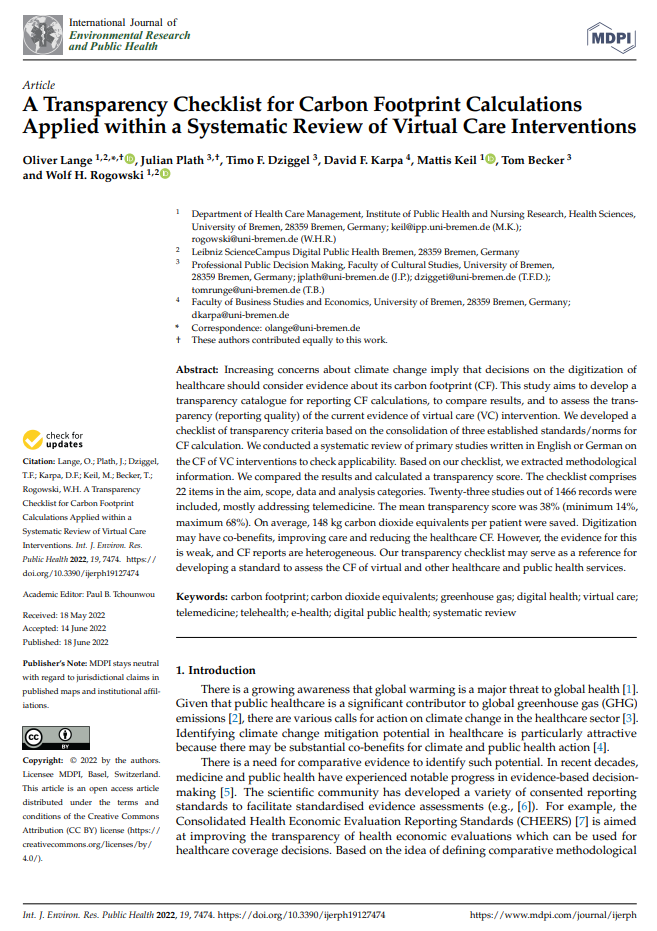
A transparency checklist for carbon footprint calculations applied within a systematic review of virtual care interventionsOliver Lange, Julian Plath, Timo F. Dziggel, and 4 more authorsInternational Journal of Environmental Research and Public Health, 2022@article{lange2022transparency, title = {A transparency checklist for carbon footprint calculations applied within a systematic review of virtual care interventions}, author = {Lange, Oliver and Plath, Julian and Dziggel, Timo F. and Karpa, David and Keil, Mattis and Becker, Tom and Rogowski, Wolf H.}, journal = {International Journal of Environmental Research and Public Health}, volume = {19}, number = {12}, pages = {7474}, year = {2022}, publisher = {MDPI}, category = {journal}, }
Working papers
-
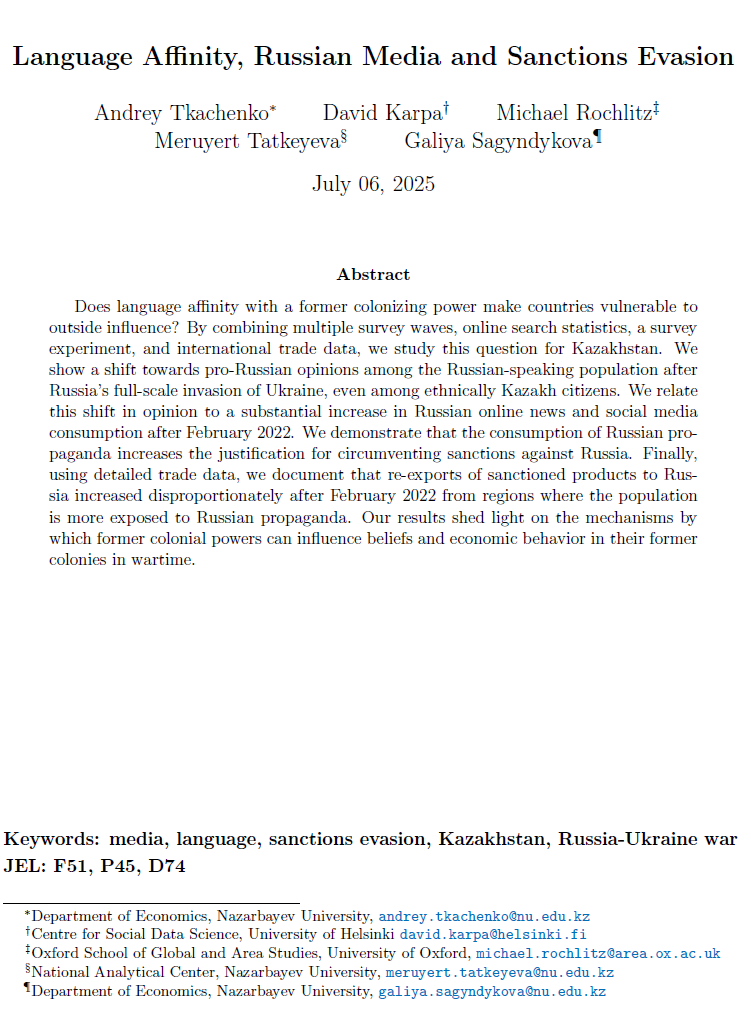
Language Affinity, Russian Media and Sanctions EvasionAndrey Tkachenko, David Karpa, Michael Rochlitz, and 2 more authors2025Available at SSRN: https://ssrn.com/abstract=5604802Does language affinity with a former colonizing power make countries vulnerable to outside influence? By combining multiple survey waves, online search statistics, a survey experiment, and international trade data, we study this question for Kazakhstan. We show a shift towards pro-Russian opinions among the Russian-speaking population after Russia’s full-scale invasion of Ukraine, even among ethnically Kazakh citizens. We relate this shift in opinion to a substantial increase in Russian online news and social media consumption after February 2022. We demonstrate that the consumption of Russian propaganda increases the justification for circumventing sanctions against Russia. Finally, using detailed trade data, we document that re-exports of sanctioned products to Russia increased disproportionately after February 2022 from regions where the population is more exposed to Russian propaganda. Our results shed light on how former colonial powers influence beliefs and economic behavior in their former colonies during wartime.
@article{tkachenko2025language, title = {Language Affinity, Russian Media and Sanctions Evasion}, author = {Tkachenko, Andrey and Karpa, David and Rochlitz, Michael and Tatkeyeva, Meruyert and Sagyndykova, Galiya}, year = {2025}, journal = {Working Paper}, type = {Working Paper}, category = {working_paper}, url = {https://ssrn.com/abstract=5604802}, doi = {10.2139/ssrn.5604802}, keywords = {Media, Language, Sanctions, Evasion, Kazakhstan, Russia-Ukraine War}, language = {English}, note = {Available at SSRN: https://ssrn.com/abstract=5604802}, } -
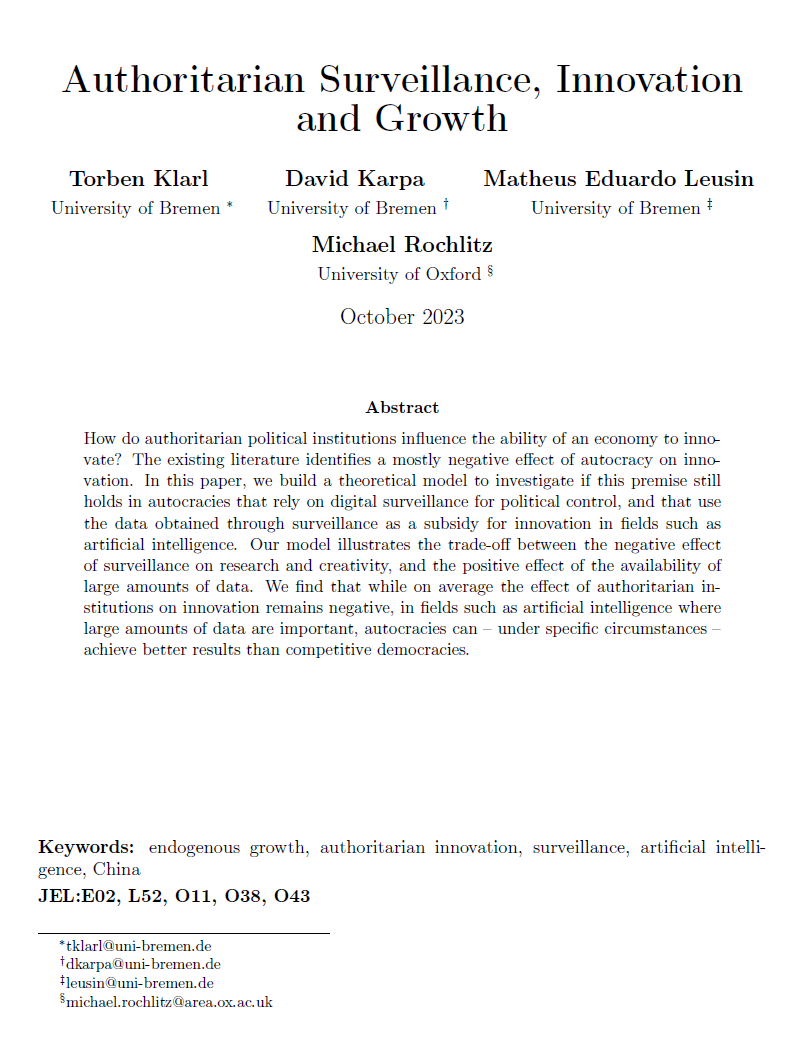
Authoritarian Surveillance, Innovation and GrowthTorben Klarl, David Karpa, Matheus Eduardo Leusin, and 1 more author2023Available at SSRN: https://ssrn.com/abstract=4594849@article{klarl2023authoritarian, title = {Authoritarian Surveillance, Innovation and Growth}, author = {Klarl, Torben and Karpa, David and Leusin, Matheus Eduardo and Rochlitz, Michael}, journal = {Working Paper}, year = {2023}, type = {Working Paper}, category = {working_paper}, url = {https://ssrn.com/abstract=4594849}, doi = {10.2139/ssrn.4594849}, note = {Available at SSRN: https://ssrn.com/abstract=4594849}, }